
ESG Data Collection and Management: Best Practices for Australian Businesses
Esg Data Management Australia is one of the most important ESG considerations for Australian businesses in 2026. Whether you’re navigating new regulatory obligations, responding to investor and customer expectations, or building a credible sustainability strategy from the ground up, this guide provides the practical, Australian-context framework you need.
For a comprehensive overview of the full pillar, read our guide to Sustainability Reporting in Australia. For the complete ESG framework, see our ESG Australia complete guide.
Scope 1, 2, and 3 Emissions Data Collection
Scope 1 (direct): measure company-owned or controlled emissions (e.g., fuel combustion, production processes, fugitive releases); use energy bills, metering, equipment specifications.
Scope 2 (purchased electricity/steam): track electricity purchased from grid; obtain utility provider data or install submeters; separate location-based vs. market-based approaches.
Scope 3 (value chain): track supplier emissions, product transport, employee commuting, waste treatment, use-phase emissions; most complex category; prioritise highest-emitting categories (often >70% of total).
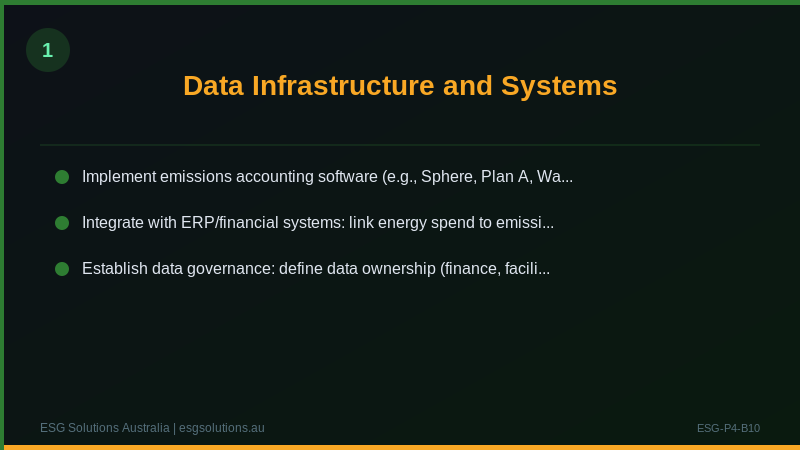
Data Infrastructure and Systems
Implement emissions accounting software (e.g., Sphere, Plan A, Watershed, Carbon Accounting Software) or build custom Excel-based system with audit trail; avoid manual spreadsheets without version control.
Integrate with ERP/financial systems: link energy spend to emissions, capturing real-time or monthly data at cost centre level for accuracy and auditability.
Establish data governance: define data ownership (finance, facilities, procurement), collection frequency, validation rules, and sign-off process by business unit heads.
Scope 3 Supply Chain Data Approach
Start with Scope 3 screening: identify top 20–30 suppliers by spend/emissions impact; request emissions data directly via CDP-style questionnaires or ESG surveys.
Emission factor methodology: use GHG Protocol Scope 3 Standard + relevant emission factors (e.g., DEFRA for Australia, IVE for transport, USDA for agriculture).
Hybrid approach for coverage: for largest suppliers, collect primary data; for smaller suppliers, use industry-average emission factors to avoid data collection paralysis.
Energy and GHG Measurement Standards
Use GHG Protocol (WRI/WBCSD standard) for Scope 1–3 calculations; applies globally and is expected by AASB S2, TCFD, and investors.
ISO 14064 certification (optional): demonstrates rigorous methodology; beneficial for high-risk sectors (mining, energy) or if external scrutiny is high.
NGER compliance: Australian entities >100 tonnes CO2-e must use NGER Measurement Methodology Determination; ensures consistency with regulatory baseline.
Scope 3 Challenges and Materiality Screening
Scope 3 category 1 (purchased goods): major source for manufacturing/retail; requires supplier engagement or product LCA; often top 2–3 categories.
Scope 3 category 4 (upstream transport): use logistics spend data × emission factors; collaborate with freight forwarders for vehicle type/distance information.
Scope 3 category 11 (use-phase emissions): only material for high-use product sectors (vehicles, appliances, fuels); calculate using product lifetime usage assumptions.
Data Quality and Audit Trail
Document data sources: maintain spreadsheet linking each emissions value to source (invoice, meter reading, supplier statement), calculation method, and assumptions.
Implement uncertainty ranges: distinguish primary data (high confidence) from secondary data (estimates); disclose key uncertainties affecting Scope 3 calculations.
Annual data reconciliation: restate prior-year data if methodology improves or significant errors identified; transparency on restatements strengthens credibility.
Third-Party Validation and Assurance
External assurance provider verifies sample of emissions data, calculation methodologies, and key assumptions; limited assurance initially, scaling to reasonable assurance.
Science-Based Targets initiative (SBTi) provides independent validation of net-zero targets; requires demonstrated Scope 1–3 measurement rigor as part of SBTi commitment letter.
Australian climate tech providers (e.g., Climate Positive) offer pre-audit services to identify data gaps before external audit commences, reducing assurance costs.
Frequently Asked Questions About Esg Data Management Australia
What data do I need for ESG reporting?
Understanding what data do i need for esg reporting is essential for Australian businesses managing their ESG obligations. The key is to combine a clear understanding of your regulatory requirements with practical, measurable action plans aligned to your materiality assessment findings and stakeholder expectations.
How do I collect it?
Understanding how do i collect it is essential for Australian businesses managing their ESG obligations. The key is to combine a clear understanding of your regulatory requirements with practical, measurable action plans aligned to your materiality assessment findings and stakeholder expectations.
What ESG data tools are available in Australia?
Understanding what esg data tools are available in australia is essential for Australian businesses managing their ESG obligations. The key is to combine a clear understanding of your regulatory requirements with practical, measurable action plans aligned to your materiality assessment findings and stakeholder expectations.
How do I ensure accuracy?
Understanding how do i ensure accuracy is essential for Australian businesses managing their ESG obligations. The key is to combine a clear understanding of your regulatory requirements with practical, measurable action plans aligned to your materiality assessment findings and stakeholder expectations.
Next Steps: Download our Free ESG Reporting Checklist
Building credible esg data management australia practices is an ongoing process that requires genuine commitment, robust data and transparent reporting. The regulatory landscape in Australia is evolving rapidly — businesses that build strong foundations now will be best positioned as obligations expand.
ESG Solutions works with Australian businesses to develop practical, credible ESG strategies tailored to your sector, size and specific obligations. Contact us today to discuss your needs.
Download our Free ESG Reporting Checklist — contact our team to get started.