
Scope 1, 2 and 3 Emissions: What They Mean and How Australian Businesses Calculate Them
Scope 1 2 3 Emissions Australia is one of the most important ESG considerations for Australian businesses in 2026. Whether you’re navigating new regulatory obligations, responding to investor and customer expectations, or building a credible sustainability strategy from the ground up, this guide provides the practical, Australian-context framework you need.
For a comprehensive overview of the full pillar, read our guide to Environmental Impact and ESG. For the complete ESG framework, see our ESG Australia complete guide.
Scope 1, 2 and 3 Emissions Explained
Scope 1 covers direct emissions from sources owned or controlled by the business, such as fleet vehicles, on-site fuel combustion, and process emissions from manufacturing facilities.
- Scope 2 comprises indirect emissions from purchased electricity, steam, heating and cooling; Australian businesses must disclose both market-based (actual grid mix) and location-based (national average) figures under AASB S2.
- Scope 3 includes all other upstream and downstream emissions in the value chain—from suppliers and transport to customer use and end-of-life disposal; for many Australian businesses, Scope 3 exceeds direct emissions by 5–10 times.
- The GHG Protocol Corporate Standard defines these boundaries globally; Australian National Greenhouse Accounts (NGA) emission factors must be applied for local accuracy under mandatory AASB S2 disclosures.
- Large Australian corporates under the Safeguard Mechanism must report Scope 1 and 2 to the Clean Energy Regulator; Scope 3 disclosure is increasingly expected by institutional investors and lenders despite not being mandated yet.
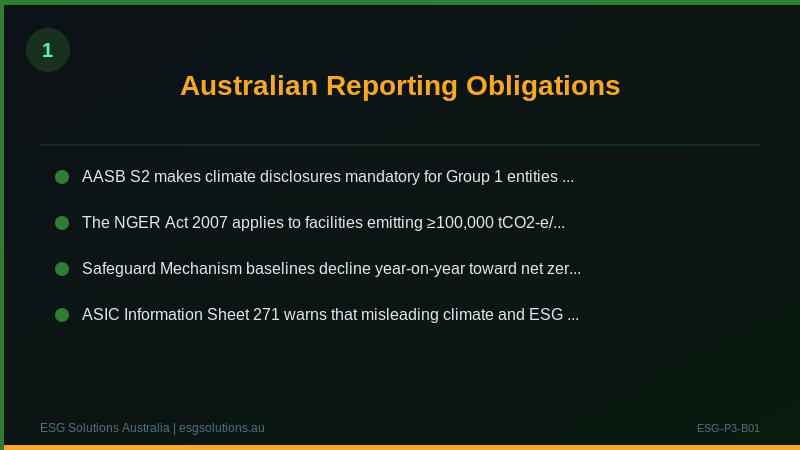
Australian Reporting Obligations
AASB S2 makes climate disclosures mandatory for Group 1 entities from 1 January 2025; Group 2 and 3 entities must comply by 1 July 2026 and 1 July 2027 respectively, creating a phased rollout across the ASX 200 and mid-cap firms.
- The NGER Act 2007 applies to facilities emitting ≥100,000 tCO2-e/year and energy use ≥600 TJ/year; annual reporting to the Clean Energy Regulator is mandatory and failure to report incurs civil penalties.
- Safeguard Mechanism baselines decline year-on-year toward net zero; facilities exceeding their baseline must surrender Australian Carbon Credit Units (ACCUs) or face financial penalties.
- ASIC Information Sheet 271 warns that misleading climate and ESG claims, especially vague ‘net zero’ statements without a credible pathway, may breach financial services laws; the ACCC updated guidance in 2023 to enforce tighter standards on environmental marketing.
Getting the Numbers Right
Australian businesses must use NGA emission factors published by the Department of Climate Change, Energy, Environment and Water; these factors are updated annually to reflect grid decarbonisation and are more accurate than international defaults.
Scope 2 calculations require separation of market-based (renewable energy purchases with specific carbon intensity) and location-based (national grid average, currently ~97 g CO2-e/kWh) methodologies; both must be reported under AASB S2.
Scope 3 quantification is often the most uncertain; leading Australian businesses establish data collection protocols with suppliers, use industry averages (e.g., Australian Government’s spend-based emission factors), and conduct sensitivity analysis to highlight uncertainties.
Common Pitfalls and How to Avoid Them
Mixing international and Australian emission factors is a common error that skews Scope 2 calculations by 20–50%; always apply NGA factors and disclose the methodology clearly to auditors.
Treating carbon offsets as ‘neutralisation’ of Scope 1 or 2 emissions (rather than separate mitigation actions) misrepresents real progress under AASB S2 and invites ASIC enforcement action.
Omitting Scope 3 entirely is risky; even if not yet mandated, institutional investors and many lenders (including major Australian banks) increasingly demand Scope 3 disclosure or penalise companies with lower ESG ratings.
Frequently Asked Questions About Scope 1 2 3 Emissions Australia
What are Scope 1, 2 and 3 emissions?
Understanding what are scope 1, 2 and 3 emissions is essential for Australian businesses managing their ESG obligations. The key is to combine a clear understanding of your regulatory requirements with practical, measurable action plans aligned to your materiality assessment findings and stakeholder expectations.
How do I calculate each?
Understanding how do i calculate each is essential for Australian businesses managing their ESG obligations. The key is to combine a clear understanding of your regulatory requirements with practical, measurable action plans aligned to your materiality assessment findings and stakeholder expectations.
Are Scope 3 mandatory under AASB S2?
Understanding are scope 3 mandatory under aasb s2 is essential for Australian businesses managing their ESG obligations. The key is to combine a clear understanding of your regulatory requirements with practical, measurable action plans aligned to your materiality assessment findings and stakeholder expectations.
What tools help?
Understanding what tools help is essential for Australian businesses managing their ESG obligations. The key is to combine a clear understanding of your regulatory requirements with practical, measurable action plans aligned to your materiality assessment findings and stakeholder expectations.
Next Steps: Book a Free Environmental Impact Assessment
Building credible scope 1 2 3 emissions australia practices is an ongoing process that requires genuine commitment, robust data and transparent reporting. The regulatory landscape in Australia is evolving rapidly — businesses that build strong foundations now will be best positioned as obligations expand.
ESG Solutions works with Australian businesses to develop practical, credible ESG strategies tailored to your sector, size and specific obligations. Contact us today to discuss your needs.
Book a Free Environmental Impact Assessment — contact our team to get started.