
Green Building and NABERS: Environmental ESG for Australian Property
Green Building Esg Australia is one of the most important ESG considerations for Australian businesses in 2026. Whether you’re navigating new regulatory obligations, responding to investor and customer expectations, or building a credible sustainability strategy from the ground up, this guide provides the practical, Australian-context framework you need.
For a comprehensive overview of the full pillar, read our guide to Environmental Impact and ESG. For the complete ESG framework, see our ESG Australia complete guide.
Green Building Standards and Performance in Australia
NABERS (National Australian Built Environment Rating System) rates commercial buildings (offices, retail, hotels) on energy, water, waste and indoor environment performance on a scale of 1–6 stars; NABERS ratings directly impact property valuation and leasing appeal.
- Green building standards (Green Star, LEED, Passivhaus) certify sustainable design and construction; Australian property developers increasingly pursue certifications to command premium leasing rates and attract ESG-conscious tenants (institutional investors, major corporates).
- Energy performance of buildings accounts for ~25% of Australia’s total emissions; green buildings reduce operational emissions by 30–50% compared to standard new construction, with significantly lower lifecycle costs.
- Commercial property investors now mandate NABERS 4-5 star or Green Star certification as minimum standards; non-compliant buildings become stranded assets with lower value, higher vacancies, and limited refinancing options.
NABERS Rating System
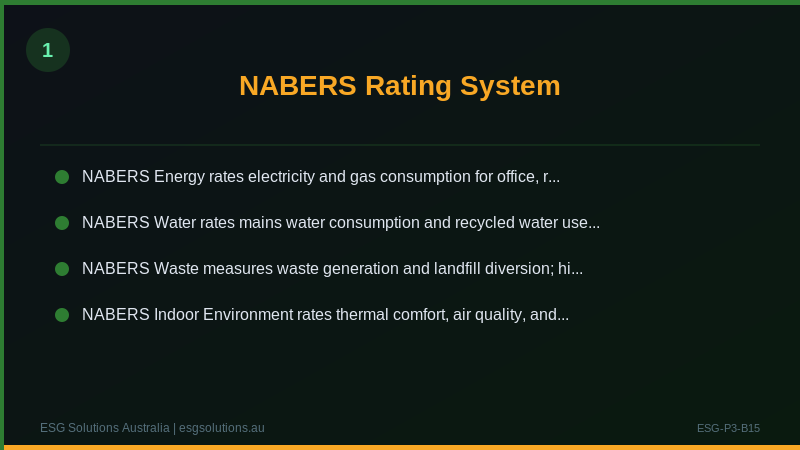
NABERS Energy rates electricity and gas consumption for office, retail, and hotel buildings; ratings depend on actual operational performance (measured via utility bills), not design; a building can be well-designed but receive a poor NABERS rating if operated inefficiently.
- NABERS Water rates mains water consumption and recycled water use; targets are set by region and building type; poor NABERS water ratings indicate high consumption relative to benchmarks, signalling efficiency improvement opportunities.
- NABERS Waste measures waste generation and landfill diversion; high-performing buildings achieve 60–80% waste diversion through segregation and resource recovery.
- NABERS Indoor Environment rates thermal comfort, air quality, and lighting; comfort directly affects employee productivity and satisfaction; poor ratings signal sick building syndrome or inadequate controls.
- Ratings are updated annually based on actual performance data; buildings can improve ratings by investing in efficiency upgrades (LED lighting, HVAC controls, building envelope), behaviour change (waste segregation training), or operational optimisation.
Energy Efficiency in Green Buildings
Green buildings typically achieve 30–50% energy savings vs. baseline through: improved insulation, triple-glazed windows, LED lighting with daylight sensors, variable-speed HVAC drives, and intelligent controls (BMS).
Renewable energy integration: rooftop solar, batteries, and smart microgrids allow buildings to generate and store renewable power; net-zero-energy buildings are increasingly viable in Australia’s sunny climate (payback 8–12 years including incentives).
Embodied carbon in materials: Green Star and other standards increasingly measure embodied carbon (lifecycle emissions from materials production and transport); low-carbon materials (timber, recycled concrete, low-carbon cement) reduce buildings’ carbon footprint by 20–40%.
Water and Waste Management in Green Buildings
Water efficiency targets include rainwater harvesting, greywater recycling, low-flow fixtures, and smart metering; modern green buildings consume 30–50% less water than conventional buildings; recycled water for non-potable uses reduces mains water reliance.
Waste management: green buildings segregate waste streams on-site (landfill, organics, recyclables); waste recovery services collect and process waste daily; high-performing buildings achieve 75–90% landfill diversion.
Circular procurement: green buildings use recycled materials, minimise waste during construction (demolition vs. renovation, waste collection targets), and design for future deconstruction and material recovery.
Financial Returns on Green Building Investment
Green buildings command 5–15% higher leasing rates and attract premium tenants (institutional investors, ESG-conscious corporates); vacancy rates are typically lower than standard buildings.
- Operating cost savings (energy, water, waste management) typically offset 20–40% of green building premium within 5–7 years; lifecycle costs are significantly lower despite higher upfront capex.
- Property valuations: green-certified buildings have higher capitalisation rates (lower risk profile); institutional investors and major funds prefer green buildings, improving refinancing terms.
- Government incentives: CEFC and ARENA offer concessional funding for green building projects; energy efficiency and renewable energy investments can be financed at below-market rates.
Retrofitting Existing Buildings
Retrofit opportunities (lighting, HVAC, controls, insulation, renewable energy) can improve NABERS ratings from 2–3 stars to 4–5 stars within 12–24 months; typical retrofit costs are AUD 300–600/m², with ROI of 7–12 years.
Progressive retrofit strategies: prioritise highest-impact measures (HVAC controls, LED lighting) in year 1, then envelope and renewable energy in years 2–3; this spreads capex and allows financing from energy savings.
Tenant incentives: landlords can offer retrofit cost sharing or rent reductions to incentivise tenant engagement in operational efficiency (waste segregation, occupancy-responsive HVAC).
Frequently Asked Questions About Green Building Esg Australia
What is NABERS?
Understanding what is nabers is essential for Australian businesses managing their ESG obligations. The key is to combine a clear understanding of your regulatory requirements with practical, measurable action plans aligned to your materiality assessment findings and stakeholder expectations.
How does Green Star relate to ESG?
Understanding how does green star relate to esg is essential for Australian businesses managing their ESG obligations. The key is to combine a clear understanding of your regulatory requirements with practical, measurable action plans aligned to your materiality assessment findings and stakeholder expectations.
How do I improve my building’s NABERS rating?
Understanding how do i improve my building’s nabers rating is essential for Australian businesses managing their ESG obligations. The key is to combine a clear understanding of your regulatory requirements with practical, measurable action plans aligned to your materiality assessment findings and stakeholder expectations.
What are the investment benefits?
Understanding what are the investment benefits is essential for Australian businesses managing their ESG obligations. The key is to combine a clear understanding of your regulatory requirements with practical, measurable action plans aligned to your materiality assessment findings and stakeholder expectations.
Next Steps: Book a Free Environmental Impact Assessment
Building credible green building esg australia practices is an ongoing process that requires genuine commitment, robust data and transparent reporting. The regulatory landscape in Australia is evolving rapidly — businesses that build strong foundations now will be best positioned as obligations expand.
ESG Solutions works with Australian businesses to develop practical, credible ESG strategies tailored to your sector, size and specific obligations. Contact us today to discuss your needs.
Book a Free Environmental Impact Assessment — contact our team to get started.