
Corporate responsibility in Australia has evolved from philanthropy and community donations into a structured, regulated and commercially significant dimension of business strategy. The social pillar of ESG — covering everything from workforce conditions and supply chain ethics to community impact and First Nations engagement — is now directly connected to regulatory compliance, investor access and brand reputation.
This guide covers what corporate responsibility means in the Australian context, what the legal obligations are, and how to build a credible social pillar ESG program from the ground up.
For context on how corporate responsibility fits into the broader ESG framework, read our complete guide to ESG in Australia.
Corporate Responsibility vs CSR vs ESG Social: Understanding the Terminology
Corporate Social Responsibility (CSR), corporate responsibility and the ESG social pillar are related but not identical concepts.
Traditional CSR in Australia often meant philanthropic giving, community programs, environmental donations and sponsorships — discretionary, largely unstructured and often disconnected from core business strategy. It was admirable but frequently cosmetic.
Corporate responsibility is a broader term that encompasses accountability for the full range of a company’s social impacts — intended and unintended — including supply chain labour conditions, workforce treatment, community impact and customer wellbeing. It’s less voluntary than traditional CSR and more closely tied to legal obligations.
The ESG social pillar is the structured, measurable and reportable dimension of corporate responsibility. It provides specific metrics, frameworks and disclosure requirements that allow stakeholders to assess your social performance objectively. The social pillar sits alongside the environmental and governance pillars in an integrated ESG framework.
Australia’s Corporate Responsibility Legal Framework
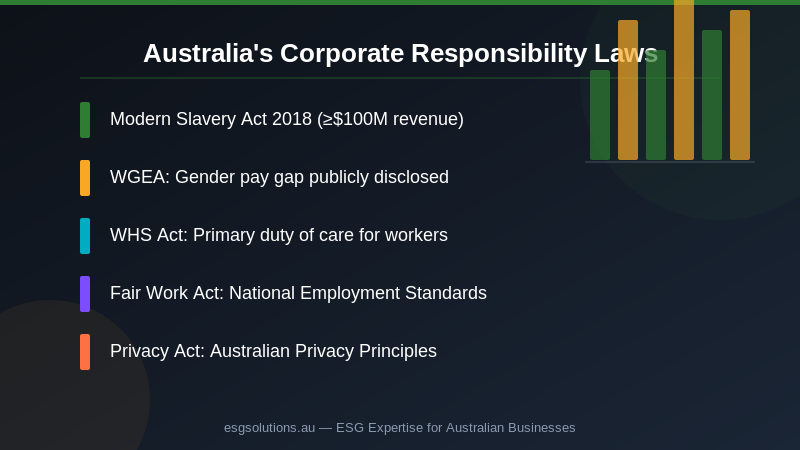
Australia has one of the world’s most comprehensive frameworks of social legislation governing corporate responsibility. Understanding these obligations is the starting point for a credible corporate responsibility program.
Modern Slavery Act 2018
Entities with annual consolidated revenue of $100 million or more must submit an annual Modern Slavery Statement covering the risks of modern slavery in their operations and supply chains, and the actions taken to address those risks. Modern slavery is defined broadly to include forced labour, child labour, human trafficking, debt bondage, servitude, and slavery-like practices including forced marriage and organ trafficking.
A compliant Modern Slavery Statement must address six mandatory criteria: the entity’s structure, operations and supply chains; the modern slavery risks in those operations and supply chains; the actions taken to assess and address those risks; how effectiveness is assessed; the process of consultation within group entities; and any other relevant information.
The Modern Slavery Act is under review, with recommendations expected to include lowering the revenue threshold and strengthening due diligence requirements — which means businesses below $100M should prepare their processes now.
Workplace Gender Equality Act (WGEA)
Private sector employers with 100 or more employees must submit an annual report to the Workplace Gender Equality Agency covering six gender equality indicators: workforce composition, gender pay equity, flexible working and leave availability, consultation with employees on gender equality issues, sexual harassment and discrimination policies, and targets relating to gender equality.
Since 2024, WGEA publishes employer-level gender pay gap data publicly. This public transparency has created significant pressure on employers with gender pay gaps that exceed industry benchmarks — gaps that were previously invisible to employees and customers are now prominently displayed. The reputational implications for employers with poorly managed pay equity are material.
Work Health and Safety Legislation
Under harmonised WHS legislation — the Work Health and Safety Act 2011 and its state and territory equivalents — persons conducting a business or undertaking (PCBUs) have a primary duty of care to ensure the health and safety of workers and others affected by the business, so far as is reasonably practicable. Officers of a PCBU have a due diligence duty to take reasonable steps to ensure the business complies with its WHS obligations.
WHS performance is a core corporate responsibility indicator. Leading metrics include Lost Time Injury Frequency Rate (LTIFR), Total Recordable Injury Frequency Rate (TRIFR), near-miss report rates and safety culture survey scores. Fatalities and serious injuries also trigger notifiable incident requirements and regulatory investigation.
Fair Work Act and Employment Standards
The Fair Work Act 2009 establishes the National Employment Standards (NES), the modern award system, enterprise bargaining provisions, and protections against unfair dismissal, adverse action and general protections breaches. Corporate responsibility in the employment domain requires compliance with these standards, fair treatment of casual and contract workers, and genuine engagement with employee representative bodies.
Australian Privacy Principles
The Privacy Act 1988 and the Australian Privacy Principles (APPs) create obligations for how organisations collect, use, disclose and protect personal information. Data privacy is increasingly recognised as a corporate responsibility dimension — businesses that fail to protect customer data or that misuse personal information face regulatory action, civil liability and reputational damage.
First Nations Corporate Responsibility in Australia
Australia’s corporate responsibility landscape has a dimension that is unique in the global context: the relationship between business and First Nations peoples. This is not simply a matter of cultural sensitivity — it is a substantive area of legal obligation, commercial risk and genuine opportunity.
Native Title and Free, Prior and Informed Consent
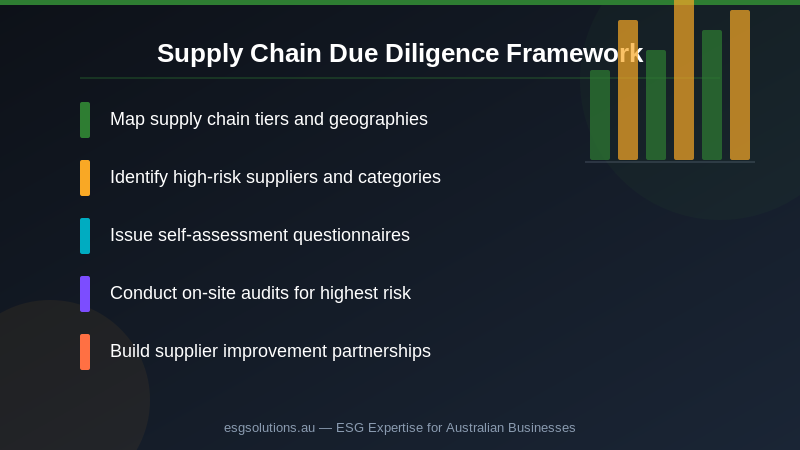
The Native Title Act 1993 recognises and protects the rights and interests of Aboriginal and Torres Strait Islander peoples in land and waters in accordance with their traditional laws and customs. Businesses undertaking projects on or near country where native title rights exist must engage with the relevant native title holders and, in many cases, negotiate Indigenous Land Use Agreements (ILUAs) before proceeding. The principle of free, prior and informed consent (FPIC) is increasingly applied as a best practice standard beyond strict legal requirements.
Reconciliation Action Plans
Reconciliation Australia administers a Reconciliation Action Plan (RAP) framework that provides a structured pathway for organisations to advance reconciliation through relationships, respect and opportunities with and for Aboriginal and Torres Strait Islander peoples. RAPs range from Reflect (for organisations beginning their reconciliation journey) through Innovate, Stretch to Elevate (for organisations with well-established reconciliation programs). A credible RAP requires genuine consultation with First Nations employees and community stakeholders, specific commitments and measurable actions.
Indigenous Supplier Diversity
Supply Nation is Australia’s peak body for Indigenous business, connecting corporate buyers with certified Indigenous enterprises. Supplier diversity programs that direct a defined percentage of procurement spend to First Nations businesses create both economic outcomes for Indigenous communities and demonstrable corporate responsibility metrics. Federal and state government procurement programs are increasingly mandating Indigenous procurement targets.
Supply Chain Corporate Responsibility
Supply chain responsibility has become one of the most complex and rapidly evolving areas of corporate responsibility practice. The combination of Modern Slavery Act requirements, Scope 3 emissions accounting, customer due diligence expectations and ESG investor screening has put supply chains under unprecedented scrutiny.
Supply Chain Risk Assessment
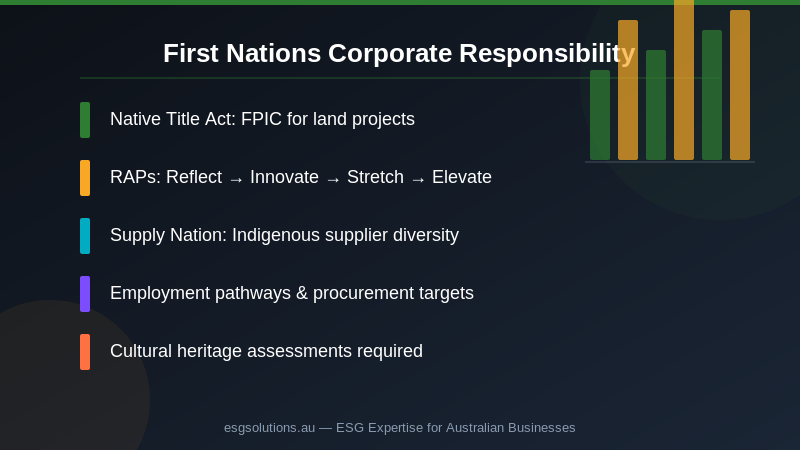
A credible supply chain corporate responsibility program begins with a risk-based approach to identifying where your most material risks sit — by geography, product category, labour intensity and tier of supply. High-risk indicators include sourcing from jurisdictions with weak labour laws or enforcement, labour-intensive production processes, long and opaque supply chains, and purchasing practices (such as very low prices or last-minute orders) that create incentives for cost-cutting at the expense of worker welfare.
Supplier Engagement and Due Diligence
Supplier engagement on corporate responsibility typically involves: supplier self-assessment questionnaires on labour standards, WHS, environmental management and business ethics; contractual requirements covering compliance with applicable laws and your standards; on-site audits or third-party assurance for highest-risk suppliers; and capacity building programs to help suppliers improve their practices over time.
The objective is continuous improvement, not simply audit-and-exit. Cutting relationships with suppliers at the first sign of problems can actually push those workers into worse conditions. A developmental approach that supports suppliers to improve is generally more effective from both an ethical and a risk management perspective.
Community Engagement and Social Investment
How your business contributes to the communities it operates in — through direct employment, local procurement, philanthropy and partnerships — is a meaningful indicator of corporate responsibility. Leading corporate responsibility programs approach social investment strategically: identifying the community issues most connected to their business operations and stakeholder base, and directing resources where they can make a genuine difference rather than spreading thin across unrelated causes.
Australian community investment frameworks often emphasise:
- Education and employment pathways for disadvantaged communities
- First Nations community programs aligned with RAP commitments
- Environmental restoration and biodiversity projects
- Regional economic development and local procurement
- Pro bono professional services to community organisations
Measuring and Reporting Corporate Responsibility
Effective corporate responsibility reporting requires consistent, comparable data across a defined set of social indicators. The GRI Standards provide the most widely used social reporting framework for Australian businesses, with specific standards covering topics including employment, labour practices, occupational health and safety, training and education, diversity and equal opportunity, human rights assessment and local communities.
Key social indicators that Australian corporate responsibility reports should address:
- Total workforce size, composition and turnover by employment type
- Gender pay gap (total remuneration and base salary)
- Board and senior leadership diversity (gender, First Nations, cultural background)
- LTIFR, TRIFR and work-related fatalities
- Modern Slavery risk assessment coverage and supplier audit completion
- Employee training hours and professional development investment
- Community investment expenditure (cash, in-kind, employee volunteering)
- Customer complaints and resolution rates
- Data breaches and privacy incidents
Corporate Responsibility Assessment: Know Where You Stand
Understanding your current corporate responsibility position — what obligations apply, how your performance compares to benchmarks, and where your most significant gaps lie — is the essential starting point for improvement.
ESG Solutions provides Corporate Responsibility Assessments tailored to the Australian regulatory context, helping businesses understand their compliance position, identify material social risks and opportunities, and build a practical roadmap for improvement.
Get a Corporate Responsibility Assessment today — contact our team to understand where your business stands on the social pillar of ESG.