
ISSB Standards in Australia: What IFRS S1 and S2 Mean for Local Businesses
Issb Standards Australia is one of the most important ESG considerations for Australian businesses in 2026. Whether you’re navigating new regulatory obligations, responding to investor and customer expectations, or building a credible sustainability strategy from the ground up, this guide provides the practical, Australian-context framework you need.
For a comprehensive overview of the full pillar, read our guide to Sustainability Reporting in Australia. For the complete ESG framework, see our ESG Australia complete guide.
ISSB Standards Architecture
ISSB (International Sustainability Standards Board) developed IFRS S1 and IFRS S2 to create a globally comparable, investor-focused sustainability disclosure baseline.
AASB adopted both standards with minimal modification, embedding them into Australian regulatory framework as AASB S1 and AASB S2 respectively.
The framework intentionally aligns with TCFD recommendations, making transition for prior TCFD reporters relatively straightforward.
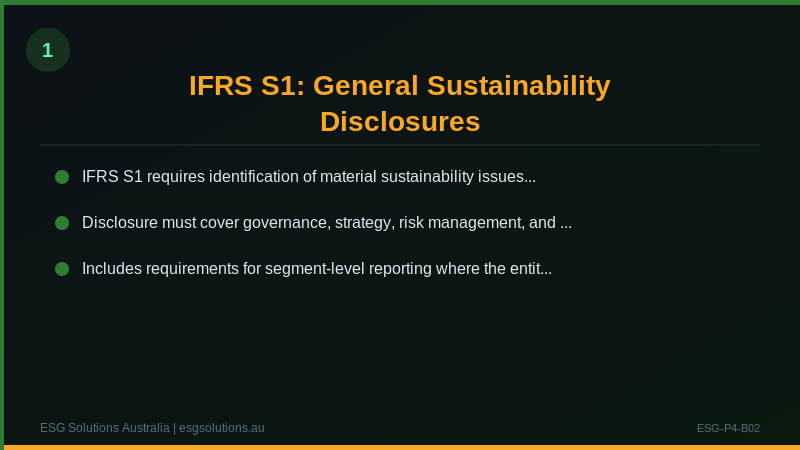
IFRS S1: General Sustainability Disclosures
IFRS S1 requires identification of material sustainability issues across all areas (climate, social, governance) using double materiality lens.
Disclosure must cover governance, strategy, risk management, and performance metrics; quantitative data must be reported where available and material.
Includes requirements for segment-level reporting where the entity has identified material climate or other sustainability risks concentrated in specific business lines.
IFRS S2: Climate-Specific Mandates
IFRS S2 mandates quantification of Scope 1, Scope 2, and where material, Scope 3 GHG emissions using GHG Protocol methodology.
Financial impact assessment required: entities must disclose gross profit, revenue, capital expenditure, and financing costs affected by climate-related risks and opportunities.
Targets and interim milestones must be disclosed with clear methodology, baseline year, and external validation where claimed (e.g., Science-Based Targets).
Australian Implementation Timeline
AASB S2 compliance is mandatory for Group 1 entities with financial year ending 30 June 2024 onwards (reporting in 2024–2025).
Early adoption is permitted for all entities; many ASX-listed companies adopted from FY24 to establish practice before mandatory audit.
Limited assurance required initially; reasonable assurance standard to be phased in by 2028 for largest entities, creating audit cost pressures.
Transition from Voluntary Frameworks
Entities previously reporting under GRI or TCFD voluntarily can map existing disclosures to AASB S2 pillars, though double materiality gap analysis is recommended.
Legacy sustainability reports may lack financial quantification (e.g., cost of decarbonisation) now mandatory under AASB S2, requiring retroactive data gathering.
Scenario analysis depth and rigour expected under AASB S2 is materially higher than typical voluntary CSR reporting, necessitating enhanced modelling capability.
Frequently Asked Questions About Issb Standards Australia
What is the ISSB?
Understanding what is the issb is essential for Australian businesses managing their ESG obligations. The key is to combine a clear understanding of your regulatory requirements with practical, measurable action plans aligned to your materiality assessment findings and stakeholder expectations.
How have Australia adopted ISSB standards?
Understanding how have australia adopted issb standards is essential for Australian businesses managing their ESG obligations. The key is to combine a clear understanding of your regulatory requirements with practical, measurable action plans aligned to your materiality assessment findings and stakeholder expectations.
How do IFRS S1 and S2 differ from AASB S1 and S2?
Understanding how do ifrs s1 and s2 differ from aasb s1 and s2 is essential for Australian businesses managing their ESG obligations. The key is to combine a clear understanding of your regulatory requirements with practical, measurable action plans aligned to your materiality assessment findings and stakeholder expectations.
Next Steps: Download our Free ESG Reporting Checklist
Building credible issb standards australia practices is an ongoing process that requires genuine commitment, robust data and transparent reporting. The regulatory landscape in Australia is evolving rapidly — businesses that build strong foundations now will be best positioned as obligations expand.
ESG Solutions works with Australian businesses to develop practical, credible ESG strategies tailored to your sector, size and specific obligations. Contact us today to discuss your needs.
Download our Free ESG Reporting Checklist — contact our team to get started.