
ESG Reporting for ASX-Listed Companies: Compliance Requirements Explained
Esg Reporting Asx Companies is one of the most important ESG considerations for Australian businesses in 2026. Whether you’re navigating new regulatory obligations, responding to investor and customer expectations, or building a credible sustainability strategy from the ground up, this guide provides the practical, Australian-context framework you need.
For a comprehensive overview of the full pillar, read our guide to Sustainability Reporting in Australia. For the complete ESG framework, see our ESG Australia complete guide.
ASX Listing Rules Sustainability Requirements
Listing Rule 4.7.3 requires annual disclosure of diversity policy and progress against measurable objectives; board and senior management diversity metrics must be disclosed.
Listing Rule 3.16 requires disclosure of material information to market via ASX announcements; companies must assess if ESG matters (e.g., environmental breach, climate target failure) are material.
Listing Rule 2.1 (‘continuous disclosure’): material developments in ESG (e.g., emissions target revision, major climate litigation) may trigger ASX announcement requirement.
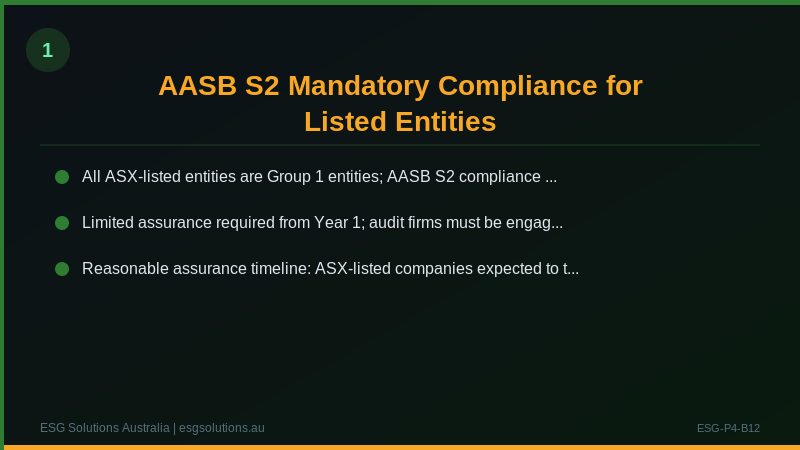
AASB S2 Mandatory Compliance for Listed Entities
All ASX-listed entities are Group 1 entities; AASB S2 compliance is mandatory from 1 January 2025 for reporting periods ending 30 June 2024 onwards.
Limited assurance required from Year 1; audit firms must be engaged by November 2024 (for FY25 reports due mid-2025) to allow adequate fieldwork.
Reasonable assurance timeline: ASX-listed companies expected to transition to reasonable assurance by FY27 (FY28 reporting); timeline may accelerate if AASB issues guidance.
Corporate Governance Council Recommendations
Recommendation 1.1: Board composition should include director with relevant ESG expertise; disclosure of how ESG competency is assessed is increasingly expected.
Recommendation 7.4: Climate risk governance; while not mandatory, ‘comply or explain’ expectation creates de-facto requirement for ASX-listed companies.
Recommendation 8.1: Remuneration should include ESG metrics; disclosure of CEO/CFO remuneration links to climate targets is now expected.
Continuous Disclosure and Materiality Assessment
Implement materiality assessment framework for ESG events: assess financial impact (cost, revenue, valuation) and reputational impact; establish threshold for ASX announcement.
Common triggers for ASX announcement: adverse climate events (stranded assets, supply chain damage), regulatory penalties (greenwashing ASIC action), target misses, or strategic pivots.
Maintain communication protocol with ASX Compliance; consult on border-line materiality calls before market close to avoid after-hours announcements.
Climate Risk in ‘Material Information’ Category
ASIC and ASX guidance clarifies climate risk as material if it could affect investor investment decision; quantify impact or describe scenario probability to establish materiality.
Examples of material climate events: supply chain disruption affecting inventory/revenue >5%, uninsured physical asset loss, climate litigation with >AUD 10M exposure.
Disclosure standard: provide same rigour for climate disclosure as for financial announcements; vague language (‘managing transition’) is insufficient.
Corporate Governance Statement and Annual Report Integration
Corporate Governance Statement (statutory section of annual report) must disclose how AASB S2 pillars (governance, strategy, risk, metrics) are integrated into board processes.
Remuneration Report must link CEO/CFO compensation to ESG targets; clearly state % of remuneration tied to climate/sustainability KPIs.
Directors’ Report: mandatory inclusion of climate risk statement detailing board oversight, management accountability, and material ESG changes during reporting period.
Audit Committee and Board Composition
Audit committee charter should explicitly include responsibility for ESG risk oversight (climate, social, governance); meeting frequency on ESG matters should be documented.
ESG board-level reporting cadence: quarterly or semi-annual climate risk dashboard to board covering emissions progress, scenario analysis updates, climate litigation watch list.
Independence and expertise: at least one audit committee member should have ESG/climate domain expertise; consider specialist recruitment or director training.
Frequently Asked Questions About Esg Reporting Asx Companies
What ESG reporting do ASX companies need?
Understanding what esg reporting do asx companies need is essential for Australian businesses managing their ESG obligations. The key is to combine a clear understanding of your regulatory requirements with practical, measurable action plans aligned to your materiality assessment findings and stakeholder expectations.
What does the ASX CGC require?
Understanding what does the asx cgc require is essential for Australian businesses managing their ESG obligations. The key is to combine a clear understanding of your regulatory requirements with practical, measurable action plans aligned to your materiality assessment findings and stakeholder expectations.
How does AASB S2 apply to listed entities?
Understanding how does aasb s2 apply to listed entities is essential for Australian businesses managing their ESG obligations. The key is to combine a clear understanding of your regulatory requirements with practical, measurable action plans aligned to your materiality assessment findings and stakeholder expectations.
Next Steps: Download our Free ESG Reporting Checklist
Building credible esg reporting asx companies practices is an ongoing process that requires genuine commitment, robust data and transparent reporting. The regulatory landscape in Australia is evolving rapidly — businesses that build strong foundations now will be best positioned as obligations expand.
ESG Solutions works with Australian businesses to develop practical, credible ESG strategies tailored to your sector, size and specific obligations. Contact us today to discuss your needs.
Download our Free ESG Reporting Checklist — contact our team to get started.