
Human Rights in the Supply Chain: An Australian Business Guide
Human Rights Supply Chain Australia is one of the most important ESG considerations for Australian businesses in 2026. Whether you’re navigating new regulatory obligations, responding to investor and customer expectations, or building a credible sustainability strategy from the ground up, this guide provides the practical, Australian-context framework you need.
For a comprehensive overview of the full pillar, read our guide to Corporate Responsibility in Australia. For the complete ESG framework, see our ESG Australia complete guide.
Human Rights Due Diligence in Supply Chains
Human rights due diligence extends beyond Modern Slavery Act compliance to encompassing labour rights (wages, hours, freedom of association), health and safety, child labour prevention, and discrimination.
- Australian entities aligned with UN Guiding Principles on Business and Human Rights undertake salient issue assessment to identify which human rights issues are most material to their business and stakeholders.
- Due diligence frameworks assess risks at each tier of the supply chain: direct suppliers, component manufacturers, raw material producers, and logistics providers—all potential vulnerability points.
- Supply chain mapping tools, supplier engagement, and third-party audits form the backbone of human rights due diligence; increasingly, entities use AI-powered supply chain visibility platforms to track risk.
Labour Rights and Fair Work Standards
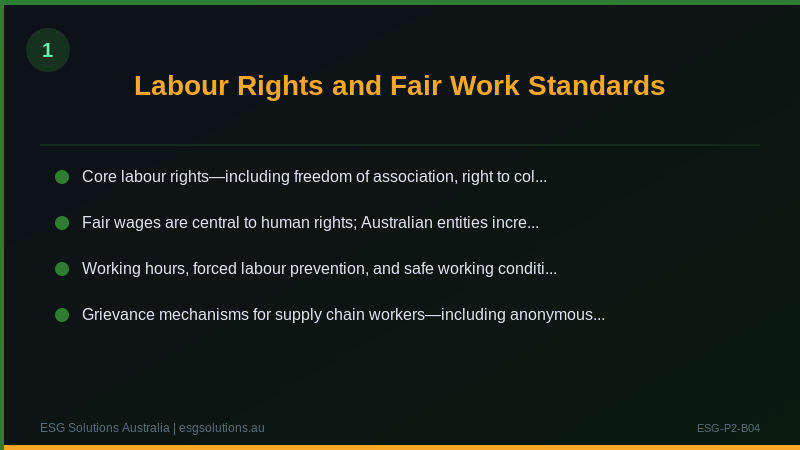
Core labour rights—including freedom of association, right to collective bargaining, prohibition of child labour, and non-discrimination—must be protected across all supply chain tiers, aligned with ILO conventions.
- Fair wages are central to human rights; Australian entities increasingly adopt ‘living wage’ benchmarks (not just legal minimum wages) in high-cost jurisdictions like Australia and premium markets.
- Working hours, forced labour prevention, and safe working conditions must be verified through audits; many Australian companies now mandate maximum weekly hours, rest periods, and hazard protocols in supplier contracts.
- Grievance mechanisms for supply chain workers—including anonymous hotlines, worker committees, and accessible complaint channels—enable early detection of labour rights abuses and worker-centred remediation.
Indigenous Rights and Cultural Heritage
Organisations operating in or sourcing from areas with Indigenous populations must respect Indigenous rights, including consultation on land use, benefit-sharing from cultural knowledge, and protection of sacred sites.
- Closing the Gap framework commits Australian businesses to advancing Indigenous wellbeing through employment pathways, procurement opportunities, and cultural competency training for staff.
- Supply chains involving Indigenous-produced materials (native plants, artwork, raw materials from Indigenous lands) require explicit benefit agreements and intellectual property protections.
- Organisations should establish advisory relationships with Indigenous communities to ensure ongoing respect for cultural protocols and address emerging human rights concerns.
Remediation and Accountability
Remediation protocols must address root causes (systemic low wages, poor governance) rather than symptoms; this may involve investing in worker training, supplier management system improvements, or technology upgrades.
- Transparent reporting on human rights findings—including numbers of workers affected, conditions remediated, and ongoing challenges—demonstrates genuine commitment and invites stakeholder accountability.
- Independent third-party assurance of human rights due diligence programs (e.g., ASAE 3000 assurance) enhances credibility and demonstrates rigorous verification of claims.
- Organisations should participate in multi-stakeholder initiatives (Responsible Business Alliance, Ethical Trading Initiative) to align standards, share best practices, and collectively influence supply chain improvement.
Frequently Asked Questions About Human Rights Supply Chain Australia
What human rights obligations exist for Australian businesses?
Understanding what human rights obligations exist for australian businesses is essential for Australian businesses managing their ESG obligations. The key is to combine a clear understanding of your regulatory requirements with practical, measurable action plans aligned to your materiality assessment findings and stakeholder expectations.
How do I assess supply chain human rights risks?
Understanding how do i assess supply chain human rights risks is essential for Australian businesses managing their ESG obligations. The key is to combine a clear understanding of your regulatory requirements with practical, measurable action plans aligned to your materiality assessment findings and stakeholder expectations.
What due diligence is required?
Understanding what due diligence is required is essential for Australian businesses managing their ESG obligations. The key is to combine a clear understanding of your regulatory requirements with practical, measurable action plans aligned to your materiality assessment findings and stakeholder expectations.
Next Steps: Get a Corporate Responsibility Assessment
Building credible human rights supply chain australia practices is an ongoing process that requires genuine commitment, robust data and transparent reporting. The regulatory landscape in Australia is evolving rapidly — businesses that build strong foundations now will be best positioned as obligations expand.
ESG Solutions works with Australian businesses to develop practical, credible ESG strategies tailored to your sector, size and specific obligations. Contact us today to discuss your needs.
Get a Corporate Responsibility Assessment — contact our team to get started.