
Australia faces some of the world’s most acute environmental risks — from Black Summer bushfires and catastrophic flooding to bleaching of the Great Barrier Reef and some of the globe’s highest per-capita greenhouse gas emissions. For Australian businesses, the environmental pillar of ESG is not a distant theoretical concern. It’s a material risk, a regulatory obligation, and — for those who get ahead of it — a genuine competitive advantage.
This guide covers the full scope of environmental ESG obligations and best practice for Australian businesses, from greenhouse gas accounting and climate risk disclosure under AASB S2 through to biodiversity, water, waste and the emerging nature-related financial disclosure framework.
For a complete overview of ESG in Australia, including the social and governance pillars, read our complete ESG Australia guide.
The Environmental Pillar: What It Covers
The environmental pillar of ESG encompasses all of a business’s interactions with the natural environment — both the impact your operations have on the environment, and the environmental conditions and changes that create risks and opportunities for your business.
In the Australian context, the key environmental ESG topics are:
- Greenhouse gas emissions: Scope 1 (direct), Scope 2 (energy) and Scope 3 (value chain)
- Climate-related risks: physical risks (floods, fires, heat, sea level rise) and transition risks (policy, technology, market shifts)
- Energy management: total consumption, renewable energy penetration, energy intensity
- Water management: consumption, recycling, wastewater, catchment risk
- Waste and circular economy: waste to landfill, recycling rates, product stewardship
- Biodiversity and land use: habitat impacts, restoration, deforestation risk
- Nature-related financial risks: dependencies and impacts on natural systems
- Pollution: air, water and soil quality impacts from operations
Greenhouse Gas Emissions: The Foundation of Environmental ESG
Greenhouse gas (GHG) emissions measurement is the central quantitative pillar of environmental ESG. Under AASB S2 — now mandatory for Group 1 entities — and increasingly expected by investors and customers, Australian businesses need a robust, auditable GHG inventory.
Understanding Emission Scopes
The GHG Protocol Corporate Standard — the international benchmark for corporate emissions accounting — categorises emissions into three scopes:
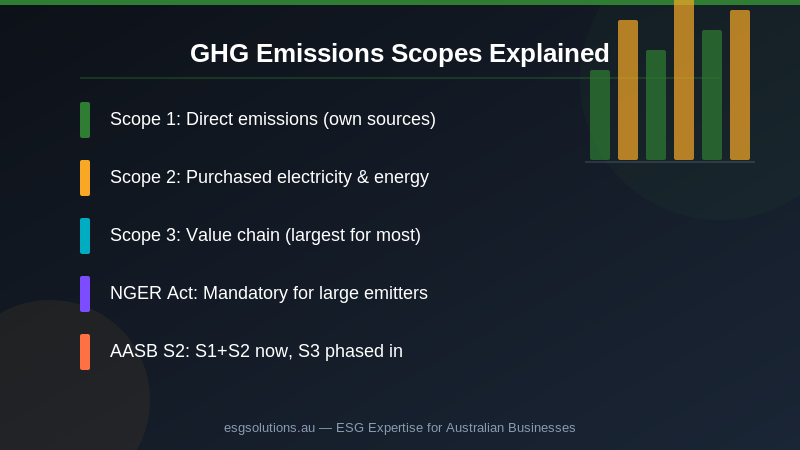
- Scope 1 — Direct emissions: From sources owned or controlled by your organisation. In Australia, this includes combustion of fossil fuels in company vehicles and equipment, process emissions, and fugitive emissions from facilities. For mining, oil and gas, and heavy industry, Scope 1 is typically the dominant emission source.
- Scope 2 — Indirect energy emissions: From the generation of purchased electricity, heat, steam or cooling consumed by your organisation. Australia’s electricity grid is among the more emissions-intensive in the OECD, though the rapid growth of renewable energy is changing this picture. Scope 2 reporting uses both location-based and market-based methods.
- Scope 3 — Other indirect emissions: All other emissions in your value chain — upstream (from goods and services you purchase, business travel, employee commuting, capital goods, waste) and downstream (from the use and disposal of your products or services, and from customer transport). For most Australian businesses, Scope 3 represents the largest share of total emissions and the most complex measurement challenge.
AASB S2 requires disclosure of Scope 1 and 2 emissions from the first mandatory reporting period, with Scope 3 disclosure required shortly thereafter. Starting your Scope 3 measurement journey now — even with category-level estimates — puts you in a significantly better position than starting under regulatory deadline pressure.
The Safeguard Mechanism and NGER
Australia’s National Greenhouse and Energy Reporting (NGER) Act requires facilities emitting more than 25,000 tonnes of CO2-equivalent per year (or groups with more than 50,000 tonnes) to report annually to the Clean Energy Regulator. The Safeguard Mechanism applies declining baselines to facilities emitting more than 100,000 tonnes — creating a compliance obligation for Australia’s largest emitters and a market for Australian Carbon Credit Units (ACCUs).
But NGER and the Safeguard Mechanism cover only the largest emitters. AASB S2 extends mandatory emissions disclosure to a much broader range of entities, and voluntary reporting to investors and customers extends it further still.
Climate Risk Disclosure Under AASB S2
AASB S2 — Australia’s adoption of the ISSB’s IFRS S2 standard — represents a fundamental change in how climate risk is disclosed. It is not a sustainability report add-on; it is integrated into financial reporting, with the same governance, processes and legal exposure as financial statements.
The Four Disclosure Pillars
AASB S2 is structured around four interconnected pillars aligned with the TCFD framework:
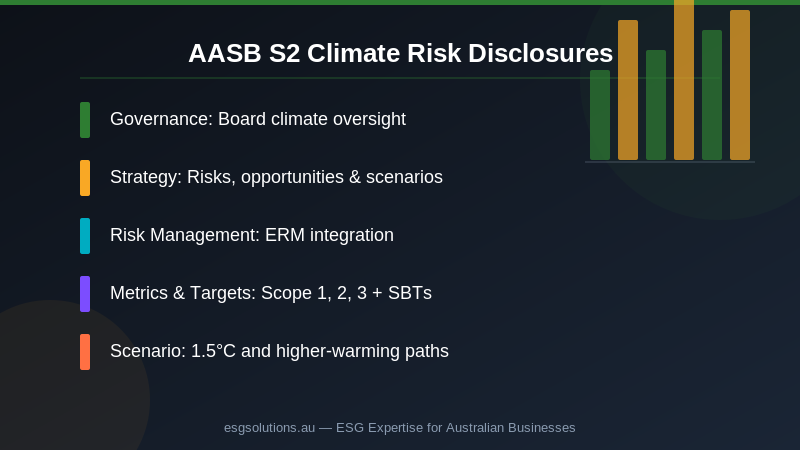
- Governance: How the board and management oversee climate-related risks and opportunities — board skills and experience, committee structures, management roles and processes
- Strategy: The climate-related risks and opportunities identified over short, medium and long timeframes; their impacts on strategy, business model and financial planning; and the results of scenario analysis using at least 1.5°C and higher-warming scenarios
- Risk Management: How climate-related risks are identified, assessed, prioritised and managed, and how this integrates with overall enterprise risk management
- Metrics and Targets: The metrics used to assess climate-related risks and opportunities (including cross-industry and industry-based metrics); Scope 1, 2 and 3 GHG emissions; and the targets set for climate-related performance
Climate Scenario Analysis
One of the most technically demanding elements of AASB S2 is the requirement for climate scenario analysis — stress-testing your business strategy and financial planning against plausible climate futures. Entities must analyse scenarios including a 1.5°C pathway (consistent with the Paris Agreement) and a higher-warming scenario.
Scenario analysis for Australian businesses should be informed by the specific physical climate risks facing Australia — elevated fire risk in south-eastern and south-western regions, increased flood frequency in Queensland and NSW, intensification of cyclones in northern Australia, and chronic water stress in agricultural regions. The IPCC, CSIRO Climate Change in Australia projections, and the Australian Climate Service all provide relevant scenario data.
Physical and Transition Risks
Physical risks arise from the direct impacts of climate change on your operations, assets, supply chains and markets. Acute physical risks include specific weather events (bushfires, floods, cyclones, heatwaves). Chronic physical risks include gradual changes like sea level rise, shifting rainfall patterns, increasing average temperatures and desertification. For Australian businesses with physical assets, agricultural exposure or coastal operations, physical risk assessment is a material exercise.
Transition risks arise from the process of shifting to a lower-carbon economy. Policy and legal risks include carbon pricing, emissions trading schemes, mandatory disclosure and standards changes. Technology risks include the disruption of incumbent industries by renewable energy, electrification and efficiency technologies. Market and reputational risks arise from changing customer preferences, changing financial sector policies and investor divestment.
Net Zero Strategy for Australian Businesses
Australia’s Climate Change Act 2022 legislates net zero by 2050. The Nationally Determined Contribution under the Paris Agreement commits to 43% emissions reduction below 2005 levels by 2030. For businesses, aligning with Australia’s net zero trajectory requires more than a pledge — it requires a credible transition plan.
Science-Based Targets
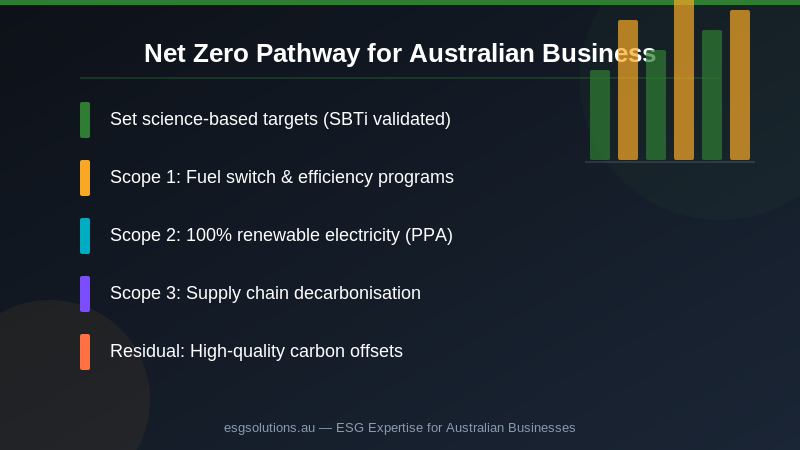
The Science Based Targets initiative (SBTi) provides a rigorous, internationally recognised methodology for corporate climate targets that are consistent with limiting global warming to 1.5°C. Australian businesses setting science-based targets commit to emissions reduction pathways validated by the SBTi — providing credibility to investors, customers and regulators that targets are genuine and aligned with global climate science.
The SBTi’s Corporate Net-Zero Standard provides a two-stage pathway: near-term targets (typically by 2030) covering significant emissions reductions across Scope 1, 2 and material Scope 3 categories; and long-term targets (by 2050 at the latest) achieving net zero through deep emissions reductions with minimal residual offsets.
Renewable Energy Procurement
Transitioning to renewable electricity is the single most impactful Scope 2 emissions reduction action available to most Australian businesses. Options include on-site solar and storage, Power Purchase Agreements (PPAs) for market-scale renewable energy procurement, and GreenPower purchases through accredited retailers. Many large Australian companies are now procuring 100% renewable electricity through PPAs — creating long-term price certainty while eliminating Scope 2 emissions.
Biodiversity and Nature: The Next Environmental ESG Frontier
Climate has dominated the environmental ESG conversation for the past decade, but biodiversity and nature loss are rapidly becoming a parallel area of regulatory and investor attention. The Taskforce on Nature-related Financial Disclosures (TNFD) published its final framework in 2023, and adoption in Australian corporate reporting is growing.
TNFD requires businesses to identify, assess and disclose their dependencies on and impacts on natural systems — water, soils, biodiversity, marine and freshwater ecosystems. For Australian businesses in agriculture, mining, property development, fisheries and forestry, nature-related risk is a material financial risk that is increasingly expected to be disclosed.
Australia’s biodiversity is among the most unique and most threatened in the world. Businesses with significant land use impacts — through agricultural operations, resource extraction, property development or infrastructure — face increasing scrutiny of their biodiversity impacts from investors, regulators and community stakeholders.
Water and Waste Management
Water stress is a material risk for many Australian businesses, particularly those in agriculture, resources, food and beverage, and utilities. Leading environmental ESG programs track total water withdrawal by source, water recycling and reuse rates, water-intensive processes and catchment risk exposure.
Waste management and circular economy practices are increasingly significant. Product stewardship obligations — including the National Television and Computer Recycling Scheme, tyre stewardship and battery stewardship programs — create compliance requirements. More broadly, investors and customers are applying circular economy lenses to business models: can resources be kept in use for longer, and can waste outputs be redesigned as inputs?
Environmental Reporting Frameworks
Australian businesses typically report environmental performance through a combination of:
- AASB S2: Mandatory climate disclosures (staged by entity size)
- NGER Act: Mandatory GHG and energy reporting for large emitters
- GRI Environmental Standards: Voluntary comprehensive environmental reporting (widely used in Australian sustainability reports)
- TNFD: Voluntary nature-related disclosures (rapidly growing in adoption)
- CDP: Voluntary disclosure platform for climate, water and forests (increasingly required by large corporate customers)
Book a Free Environmental Impact Assessment
Understanding your environmental ESG position — your emissions baseline, climate risk exposure, and gap to AASB S2 readiness — is the essential first step in building a credible environmental pillar.
ESG Solutions provides Environmental Impact Assessments tailored to the Australian regulatory context, covering GHG inventory development, climate risk assessment, scenario analysis readiness and AASB S2 gap analysis.
Book a Free Environmental Impact Assessment with our team today to understand where your business stands and what to prioritise next.