
Building an ESG strategy in Australia in 2026 is no longer optional for businesses that want to attract capital, win contracts with major corporates, retain talent and stay on the right side of an increasingly active regulator. The question isn’t whether to develop one — it’s how to build one that’s credible, measurable and genuinely integrated into how your business operates.
This guide walks you through a complete ESG strategy framework designed for the Australian regulatory and market context. From materiality assessment through to implementation and reporting, it’s a practical roadmap that works for businesses of all sizes.
Read our full ESG Australia guide for a comprehensive overview of all three pillars before diving into strategy specifics.
What Is an ESG Strategy?
An ESG strategy is a structured plan for how your organisation identifies, manages and reports on its environmental, social and governance impacts, risks and opportunities. It connects your sustainability ambitions to concrete targets, governance structures, operational processes and external reporting commitments.
Critically, an ESG strategy is not a separate document created for investors and then ignored internally. The organisations generating real value from ESG have integrated their strategy into their core business model — where sustainability performance sits alongside financial performance as a strategic priority.
Why Australian Businesses Need a Formal ESG Strategy in 2026
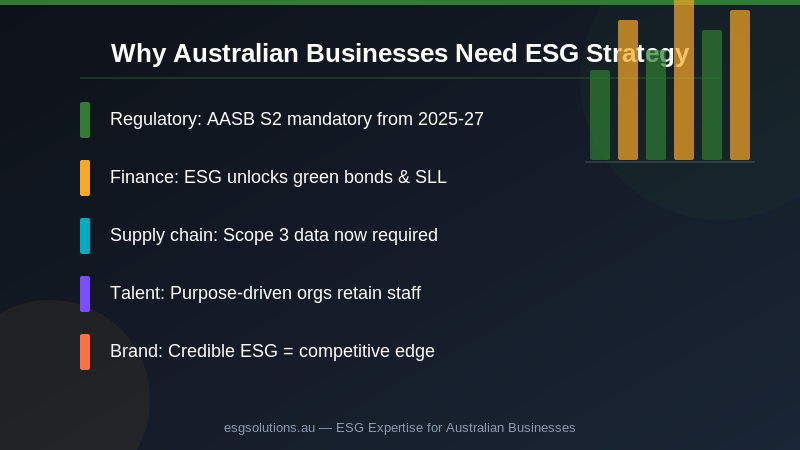
Four converging forces are making a formal ESG strategy essential for Australian businesses right now.
Regulatory Pressure
Mandatory climate disclosures under AASB S2 are in force for Group 1 entities from 1 January 2025, with Group 2 entities (large unlisted companies meeting size thresholds) from 1 July 2026. Beyond climate, the Modern Slavery Act, WGEA reporting, NGER obligations and the Fair Work Act all create structured reporting demands across the social and governance pillars. A formal ESG strategy ensures your compliance obligations are managed proactively rather than reactively.
Capital and Finance Access
Australia’s major banks and institutional investors have published ESG integration policies that assess the sustainability credentials of the businesses they finance. Poor ESG credentials can translate directly into higher borrowing costs, reduced access to green finance products, and exclusion from ESG-screened investment mandates. Conversely, businesses with credible ESG strategies are accessing green bonds, sustainability-linked loans and impact investment capital at competitive rates.
Supply Chain Requirements
Australia’s large listed companies are under pressure to report Scope 3 emissions — which means they need emissions and ESG data from their suppliers. Government procurement policies in many jurisdictions now include sustainability criteria. If your customers are ASX-listed companies or government agencies, having a documented ESG strategy may become a prerequisite for retaining their business.
Talent and Reputation
Research consistently shows that purpose-driven organisations attract and retain talent more effectively — particularly from Gen Z and millennial cohorts who are more likely to select employers based on values alignment. An ESG strategy with genuine commitments and transparent reporting supports employer brand, helps with talent acquisition and can reduce the cost of employee turnover.
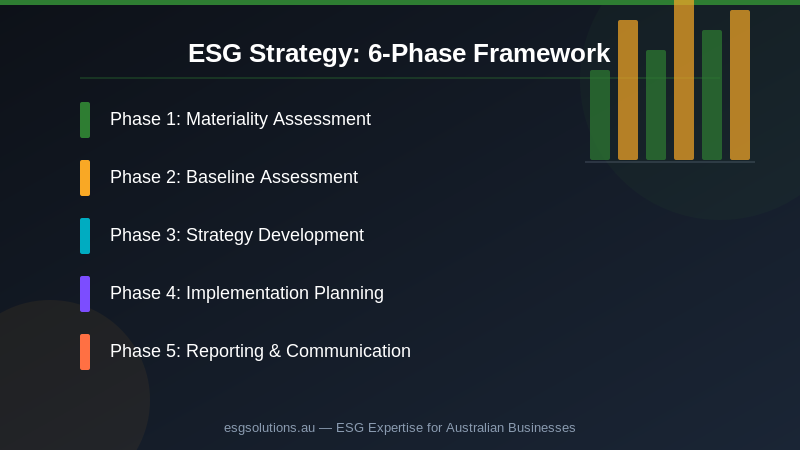
The ESG Strategy Framework: Six Phases
Here is the framework we use with Australian businesses to build ESG strategies that are both credible and practical.
Phase 1: Materiality Assessment
A materiality assessment is the foundation of any credible ESG strategy. It identifies which environmental, social and governance topics are most significant — both in terms of their impact on the business and their impact on the external world.
The GRI Standards use a double materiality lens: financial materiality (risks and opportunities that affect business value) and impact materiality (your business’s effects on people and planet). AASB S2 focuses on climate-related financial materiality specifically.
A robust materiality process typically involves:
- A desktop review of peer reporting and sector-specific ESG benchmarks
- Stakeholder engagement — surveys, interviews or workshops with employees, investors, customers, suppliers and community representatives
- An internal risk and opportunity assessment mapping ESG topics to business impact
- A materiality matrix that visually plots topics by their significance to stakeholders and to the business
The output should be a prioritised list of material ESG topics that informs both your strategy and your reporting priorities.
Phase 2: Baseline Assessment
Before setting targets, you need to know where you stand. A baseline assessment covers your current performance across each material ESG topic:
- Environmental baseline: greenhouse gas inventory (Scope 1, 2 and priority Scope 3 categories), energy and water consumption data, waste metrics
- Social baseline: workforce diversity ratios and pay equity data, WHS statistics, Modern Slavery exposure mapping, community investment expenditure
- Governance baseline: board composition assessment against ASX CGC Principles, policy inventory (code of conduct, anti-bribery, whistleblower), risk register ESG integration
Data quality matters significantly for your AASB S2 climate disclosures — you’ll need to be able to substantiate your numbers and demonstrate your measurement methodology. Start building robust data collection systems early.
Phase 3: Strategy Development
Your ESG strategy should articulate:
- Vision and purpose: why ESG matters to your business and what kind of organisation you’re committed to being
- Strategic priorities: the material ESG topics that will receive the most attention and resource investment
- Targets and milestones: specific, time-bound commitments for each strategic priority — science-based emissions targets, DEI representation milestones, governance implementation timelines
- Governance structure: who owns ESG at board level, executive level and operational level; how ESG performance is reported and reviewed
- Integration plan: how ESG will be embedded into existing business functions — procurement, HR, finance, risk management, capital allocation
The strategy document itself doesn’t need to be long — a clear, well-evidenced 20-page strategy will be more effective than a glossy 100-page document that no one reads or acts on.
Phase 4: Implementation Planning
Strategy without an implementation plan is wishful thinking. Your implementation plan should translate strategic priorities and targets into specific actions, with owners, timelines and resource requirements. For each ESG initiative:
- Who owns it (accountable executive, operational lead)
- What success looks like at 12, 24 and 36 months
- What budget and resources are required
- What barriers or risks could impede implementation
- How progress will be measured and reported internally
Prioritise initiatives based on a combination of strategic importance, regulatory urgency, implementation difficulty and resource requirements. Quick wins — initiatives that are low-cost, high-visibility and relatively simple to implement — are valuable early in your ESG journey for building internal momentum and demonstrating commitment.
Phase 5: Reporting and Communication
External ESG reporting is both a compliance requirement (for entities covered by AASB S2, Modern Slavery Act, WGEA) and a strategic communication tool. Your annual ESG or sustainability report should:
- Align with an established framework (GRI Standards and/or AASB S1/S2 as applicable)
- Report against your stated targets with actual performance data
- Acknowledge areas of underperformance honestly — credibility requires transparency about challenges, not just achievements
- Include appropriate management commentary on context, strategy and forward commitments
- Be supported by a data appendix with sufficient detail for sophisticated readers
For AASB S2 disclosures specifically, the reporting requirements are structured around four pillars: governance, strategy, risk management, and metrics and targets. Begin mapping your existing governance and risk management practices to these requirements well before your mandatory reporting date.
Phase 6: Continuous Improvement
ESG strategy is not a set-and-forget exercise. The regulatory landscape is evolving rapidly, stakeholder expectations are rising, and the body of available ESG data, frameworks and best practice guidance is expanding continuously. Build in an annual cycle of strategy review, materiality reassessment and target recalibration — and be prepared to respond to significant regulatory changes, peer practice updates and new scientific guidance.
ESG Strategy for Different Business Types
Listed Companies
Listed companies face the most comprehensive ESG disclosure expectations — mandatory AASB S2 climate disclosures, ASX CGC Principles compliance-or-explain requirements, WGEA reporting, and strong investor and proxy advisor scrutiny of governance quality. ESG strategy at this level requires board-level ownership, dedicated internal resources, external advisory support and a clear assurance pathway for climate data.
Large Unlisted Companies
Large unlisted companies approaching the Group 2 mandatory disclosure threshold (from 1 July 2026) should be building their ESG data systems, governance frameworks and reporting capabilities now. The regulatory gap from listed to unlisted has closed significantly — the mandatory requirements are largely the same, just arriving on a different timeline.
SMEs
Australian SMEs face a different but real set of ESG pressures — primarily through supply chain requirements from large corporate clients, talent market expectations and access to finance. A practical SME ESG strategy focuses on the most material issues, builds from a realistic baseline and demonstrates genuine commitment through specific commitments and transparent reporting — without trying to match the complexity of large corporate ESG programs.
Key ESG Strategy Metrics for Australian Businesses
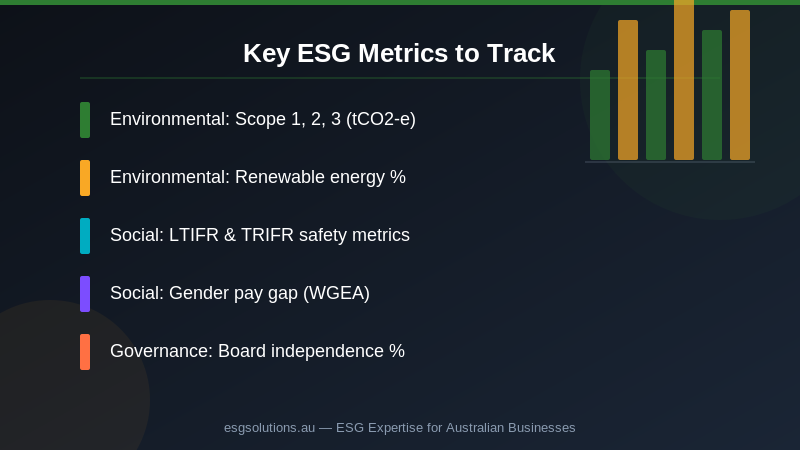
Across the three pillars, here are the core metrics that Australian ESG strategies should track and report:
Environmental: Total Scope 1, 2 and 3 GHG emissions (tCO2-e); emissions intensity (per dollar of revenue or per unit of production); energy consumption and intensity; renewable energy percentage; water consumption and recycled water percentage; waste to landfill and recycling rate.
Social: LTIFR and TRIFR; gender pay gap (total remuneration and base salary); board and executive gender diversity; First Nations employment percentage; Modern Slavery supplier assessment coverage; employee engagement score; net promoter score (customer).
Governance: Board independence percentage; board gender diversity; audit committee independence; ethics training completion rate; whistleblower disclosures received and actioned; ESG targets in executive remuneration; percentage of suppliers with signed code of conduct.
Common ESG Strategy Pitfalls to Avoid
The most effective ESG strategies share a common characteristic: they’re genuinely integrated into how the business operates, not bolted on as an afterthought. Here are the pitfalls that derail well-intentioned ESG programs.
Lack of board ownership: ESG strategy driven only at the operational level rarely achieves meaningful change. Board-level accountability — through a dedicated ESG committee, board skills matrix inclusion and executive remuneration linkage — is what signals genuine commitment.
Targets without resourcing: Setting ambitious ESG targets without allocating the budget, people and technology to achieve them creates an immediate credibility gap. Every target should have a corresponding implementation plan and resource allocation.
Over-reporting, under-acting: The inverse of greenwashing is common too — producing detailed, well-formatted ESG reports that mask limited actual progress on material issues. Quality reporting should reflect quality management, not substitute for it.
Ignoring sector-specific context: ESG strategy in the mining sector looks very different from ESG in financial services or retail. Generic frameworks need to be contextualised for your industry’s specific material risks, regulatory obligations and stakeholder expectations.
Build Your ESG Strategy with ESG Solutions
A credible, integrated ESG strategy is one of the most valuable investments an Australian business can make right now — commercially, reputationally and in terms of regulatory readiness.
ESG Solutions works with Australian businesses across sectors to build ESG strategies that are genuinely fit for purpose — grounded in materiality, aligned to the regulatory landscape and integrated into core business operations.
Book a Free ESG Strategy Session today to understand where your business stands, what your most material risks and opportunities are, and what a practical roadmap looks like for your specific context.