
Setting ESG Goals and Targets: A Practical Framework for Australian Businesses
Esg Goals And Targets Australia is one of the most important ESG considerations for Australian businesses in 2026. Whether you’re navigating new regulatory obligations, responding to investor and customer expectations, or building a credible sustainability strategy from the ground up, this guide provides the practical, Australian-context framework you need.
For a comprehensive overview of the full pillar, read our guide to ESG Strategy for Australian Businesses. For the complete ESG framework, see our ESG Australia complete guide.
What Is ESG Reporting?
The process of measuring, disclosing and communicating an organisation’s environmental, social and governance performance to stakeholders
In Australia, ESG reporting encompasses both mandatory obligations (AASB S2, Modern Slavery Act, WGEA, NGER) and voluntary frameworks (GRI Standards, CDP)
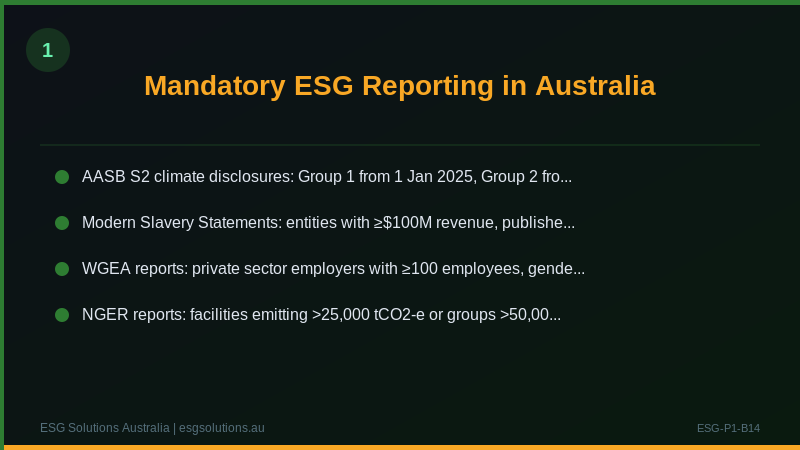
Mandatory ESG Reporting in Australia
AASB S2 climate disclosures: Group 1 from 1 Jan 2025, Group 2 from 1 Jul 2026, Group 3 from 1 Jul 2027
- Modern Slavery Statements: entities with ≥$100M revenue, published annually on Australian Border Force register
- WGEA reports: private sector employers with ≥100 employees, gender pay gap data published publicly
- NGER reports: facilities emitting >25,000 tCO2-e or groups >50,000 tCO2-e
GRI Standards — the Voluntary Benchmark
World’s most widely adopted sustainability reporting framework, used by most large Australian companies
- Universal Standards (GRI 1, 2, 3) — governance, strategy, materiality, stakeholder engagement
- Topic-specific standards covering all material ESG topics — environment, social, governance
- GRI ‘In Accordance’ reporting requires comprehensive disclosure against all applicable topic standards
What Makes a High-Quality ESG Report
Materiality-driven: disclosures prioritised by material issues, not a comprehensive catalogue of minor activities
- Data quality: quantitative metrics with consistent methodology, prior-period comparatives and third-party verification
- Target transparency: progress against stated targets reported honestly — including areas where targets are not being met
- Integrated narrative: ESG performance connected to business strategy and financial performance
ESG Reporting Best Practices for Australian Businesses
- Start early: building data systems, governance processes and assurance relationships takes time
- Be consistent: year-on-year consistency in metrics and methodology allows meaningful trend analysis
- Be honest: transparent reporting on challenges and underperformance builds more credibility than airbrushed narratives
- Seek assurance: even voluntary limited assurance improves data quality and investor confidence
Frequently Asked Questions About Esg Goals And Targets Australia
How do I set ESG targets?
Understanding how do i set esg targets is essential for Australian businesses managing their ESG obligations. The key is to combine a clear understanding of your regulatory requirements with practical, measurable action plans aligned to your materiality assessment findings and stakeholder expectations.
What is the difference between goals and targets?
Understanding what is the difference between goals and targets is essential for Australian businesses managing their ESG obligations. The key is to combine a clear understanding of your regulatory requirements with practical, measurable action plans aligned to your materiality assessment findings and stakeholder expectations.
Should I use science-based targets?
Understanding should i use science-based targets is essential for Australian businesses managing their ESG obligations. The key is to combine a clear understanding of your regulatory requirements with practical, measurable action plans aligned to your materiality assessment findings and stakeholder expectations.
How do I align targets to material issues?
Understanding how do i align targets to material issues is essential for Australian businesses managing their ESG obligations. The key is to combine a clear understanding of your regulatory requirements with practical, measurable action plans aligned to your materiality assessment findings and stakeholder expectations.
Next Steps: Book a Free ESG Strategy Session
Building credible esg goals and targets australia practices is an ongoing process that requires genuine commitment, robust data and transparent reporting. The regulatory landscape in Australia is evolving rapidly — businesses that build strong foundations now will be best positioned as obligations expand.
ESG Solutions works with Australian businesses to develop practical, credible ESG strategies tailored to your sector, size and specific obligations. Contact us today to discuss your needs.
Book a Free ESG Strategy Session — contact our team to get started.